Recently, the research team led by Professor Xin-Nian Wang at the Institute of Particle Physics, Central China Normal University and Prof. Shanshan Cao at the Advanced Interdisciplinary Science Research Institute of Shandong University, achieved a significant breakthrough in jet theory and phenomenology in heavy-ion collisions. For the first time, they proposed the production mechanism of "thermal recoil jets" in high-energy heavy-ion collisions, opening a new perspective for understanding the properties of strongly interacting matter under extreme conditions. The related findings were published in the recent issue of the top physics journal Physical Review Letters, under the title "Emergence of Thermal Recoil Jets in High-Energy Heavy-Ion Collisions." The work was co-corresponded by Professor Xin-Nian Wang from Central China Normal University and Professors Shanshan Cao and Li Yi from Shandong University, with Shandong University graduate student Peng Jing as the first author, and graduate students Yichao Dang, Lejing Zhang, and Yang He (now a postdoctoral fellow at the University of Science and Technology of China) as co-authors.
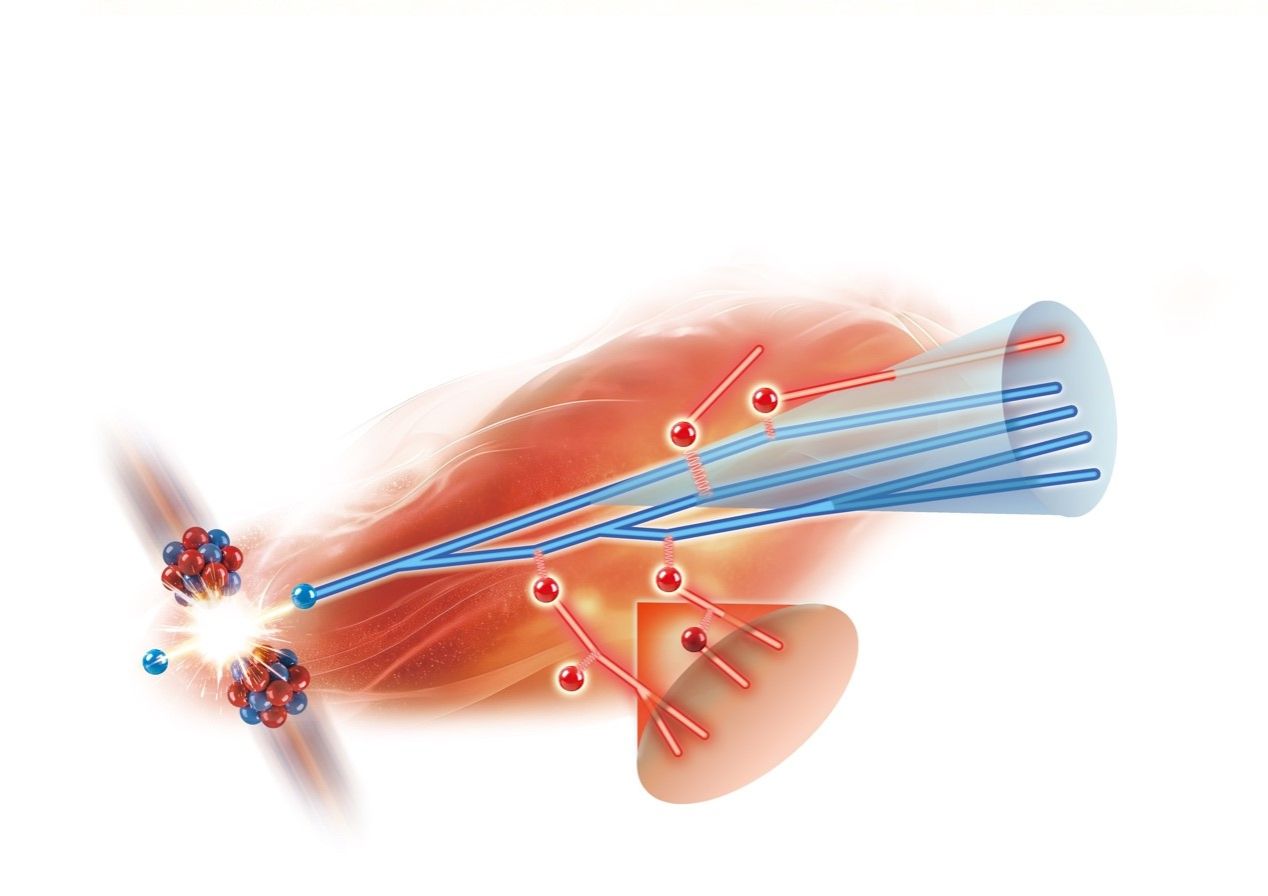
In the conventional picture of high-energy heavy-ion collisions, energetic quarks and gluons are produced via hard scattering and subsequently evolve into hadronic jets seen in the detectors. In such relativistic heavy-ion collisions, a quark-gluon plasma (QGP) is formed with temperatures reaching up to five trillion degrees, a state reminiscent of the primordial matter just after the Big Bang in the early universe. High-energy jets produced in the early stage of the collisions are used to "X-ray" the internal microscopic structure of the QGP. Based on the linear Boltzmann transport model developed over many years by Xin-Nian Wang's team, this study reveals for the first time that when jets traverse the QGP medium, the energy they lose can effectively excite the surrounding medium, giving rise to a new class of jet structures dominated by particles from the medium response. The team named this newly identified jet species as "thermal recoil jets."
Unlike conventional "hard jets" produced by hard scattering, thermal recoil jets exhibit markedly different internal structural characteristics: their energy distribution no longer concentrates in the central region but instead spreads outward in a relatively flat manner; meanwhile, the energy spectra of their internal particles more closely resemble the thermal distribution of QGP medium particles. These distinctive properties provide a natural explanation for the long-standing puzzle of the enhancement of hadron-triggered jets observed in recent heavy-ion experiments, particularly in terms of the dependence on jet momentum and cone size where the team’s theoretical predictions show excellent agreement with experimental data. This discovery not only deepens our understanding of the jet quenching mechanism but also offers a new avenue for exploring the interactions between high-energy partons and extremely dense nuclear matter. This work was supported by the National Natural Science Foundation of China.
Article link: https://journals.aps.org/prl/abstract/10.1103/9x1t-b84m