The “C3NT Workshop on Global Constraints on QGP Properties” was held in the Central China Center for Nuclear Theory (C3NT) on the CCNU campus. Researchers in nuclear physics from many top universities and research institutions across the country gathered together to discuss the latest advances in heavy-ion collisions and related areas.
The workhop brought together nearly 30 experts, including Prof. Ma Yugang, President of East China Normal University, and Prof. Liang Zuotang of Shandong University, for in-depth exchanges and discuss about the nature of QGP transport, jet quenching, heavy quark transport, spin polarization and correlation, UPC and other topics.

Academician Liang Zuotang of Shandong University presided over the meeting

Professor Guangyou Qin, Dean of the College of Physical Science and Technology of
CCNU

Professor Xin-nian Wang, Director of C3NT and IOPP
In the morning session of January 26, chaired by Prof. Zuotang Liang, Prof. Guangyou Qin, Dean of the College of Physical Science and Technology of CCNU, and Prof. Xinnian Wang, Director of C3NT, welcomed all participants to CCNU and scientific discussions. During the workshop, invited speakers presented 13 overview talks covering topics such as lattice QCD, jet transport coefficients in heavy-ion collisions, heavy-quark transport, quarkonium production and transport, collective flow, spin polarization, UPC and QGP properties. Prof. Yugang Ma, President of East China Normal University and member of the Chinese academy of science, gave a keynote presentation titled “Chinese Contributions to STAR,” in which he reviewed major achievements by China STAR team, drawing broad resonance from the participants. The meeting concluded successfully amid lively discussions.
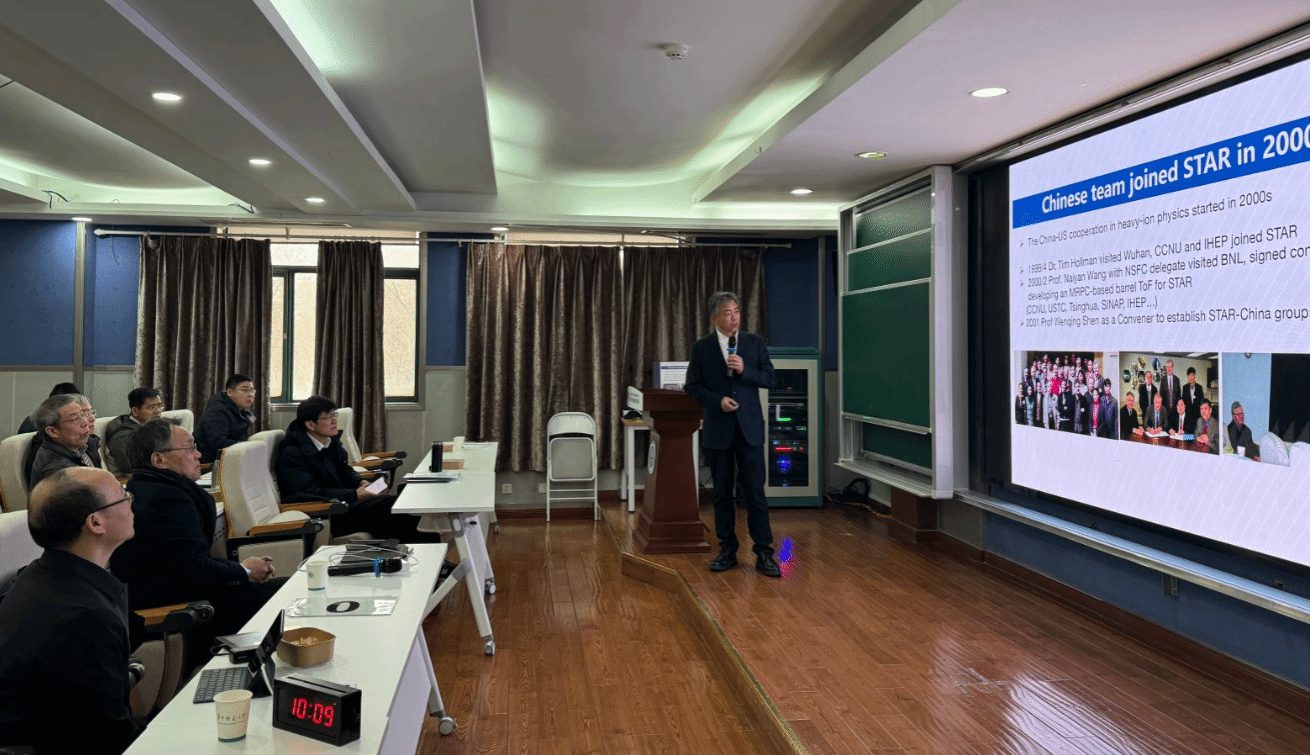
Academician Yugang Ma, President of East China Normal University
As the host institution, the Central China Center for Nuclear Theory (C3NT) at Central China Normal University (CCNU), supported by the Institute of Particle Physics (IOPP), is committed to long-term basic research in nuclear structure and hadron physics, nuclear matter under extreme conditions, nuclear astrophysics, and quantum computing and artificial intelligence in nuclear physics, while actively promoting domestic and international academic exchanges. The successful convening of this workshop has further enhanced C3NT’s academic impact in the fields of heavy-ion physics and QGP research, and injected new vitality into the development of nuclear physics in China.

Group Photo of the C3NT Workshop on Global Constraints on QGP Properties
Correspondent: Xiangyu Shui
Proof-reader: Guangyou Qin, Xin-Nian Wang