On the morning of November 28, 2025, the Fifth IOPP Colloquium was successfully held in Lecture Hall 9409 of Building 9 at the Institute of Particle Physics (IOPP), Central China Normal University. Professor Jun Cao, Researcher and Director of the Institute of High Energy Physics (IHEP) of the Chinese Academy of Sciences, was invited to deliver an academic report titled "First Results of JUNO" to faculty and students.
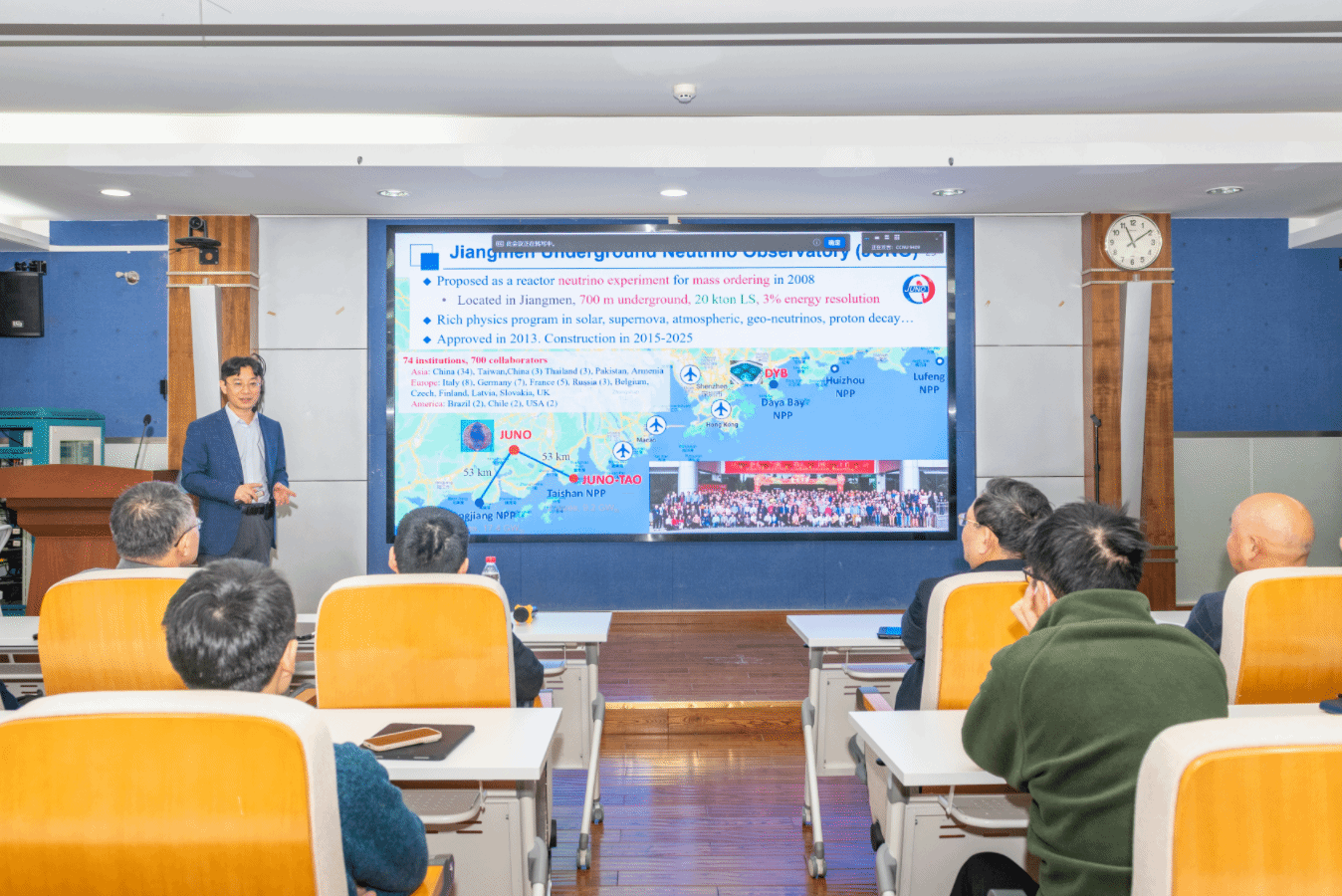
In his report, Professor Cao systematically introduced the ten-year journey of JUNO from its proposal and construction to the acquisition of the first scientific results. As the first completed and operational facility among the three major next-generation neutrino experiments worldwide, JUNO is located 700 meters underground, features a core detector of 20,000 tons of liquid scintillator, and officially began scientific data collection on August 26, 2025. Professor Cao specifically highlighted that in the initial results released on November 19, JUNO improved the measurement precision of the neutrino mixing parameters sin²θ₁₂ and Δm²₂₁ by factors of 1.5 and 1.8, respectively, setting the best measurement records in this field over the past 50 years.
Regarding technological breakthroughs, Professor Cao emphasized JUNO's core innovations: a 35.4-meter-diameter acrylic spherical container filled with 20,000 tons of liquid scintillator; a detection system comprising 17,612 20-inch photomultiplier tubes and 25,600 3-inch photomultiplier tubes, achieving a detection efficiency of 78%; and a 40-kiloton water Cherenkov detector for background shielding. These technologies enable JUNO to achieve an outstanding energy resolution of 3%.
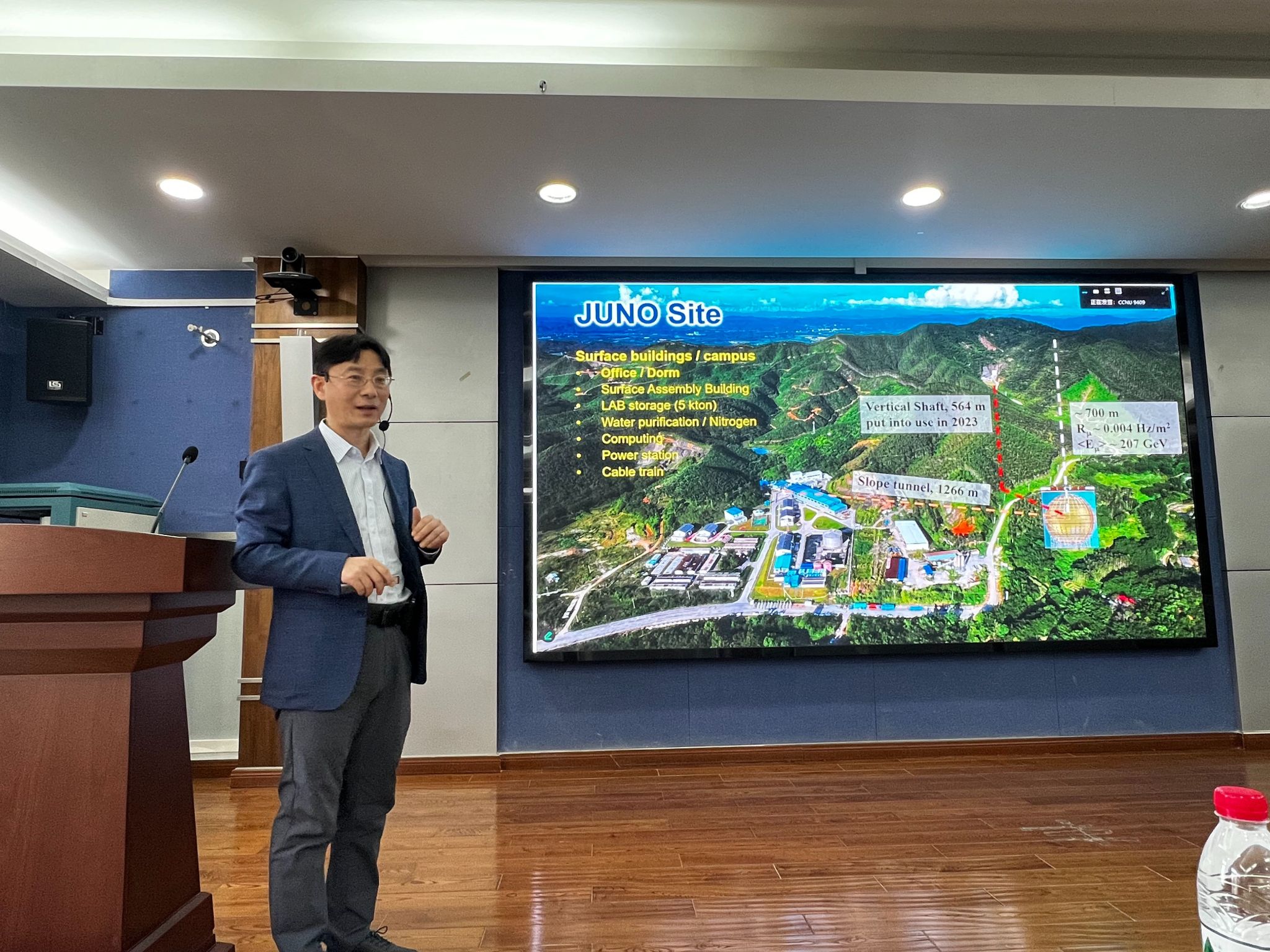
During the thematic discussion session, Professor Cao engaged in in-depth exchanges with young scholars on cutting-edge issues such as neutrino mass ordering measurements and reactor neutrino energy spectrum anomalies. Professor Cao emphasized, "JUNO will not only address the core issue of neutrino mass ordering but will also serve as a multi-physics target detection platform, producing internationally leading results in research areas including supernova neutrinos, solar neutrinos, and geoneutrinos." Faculty and students enthusiastically discussed topics including key detector technologies and collaborative research between the Taishan Neutrino Experiment (TAO) and JUNO.
The IOPP Colloquium is a series of high-end academic activities organized by the Institute of Particle Physics. This report fully demonstrated the latest breakthroughs in China's large-scale scientific facility construction and basic scientific research, providing attendees with a valuable opportunity to exchange ideas with world-class scholars and further highlighting Central China Normal University's academic vision of "international perspective and interdisciplinary integration."
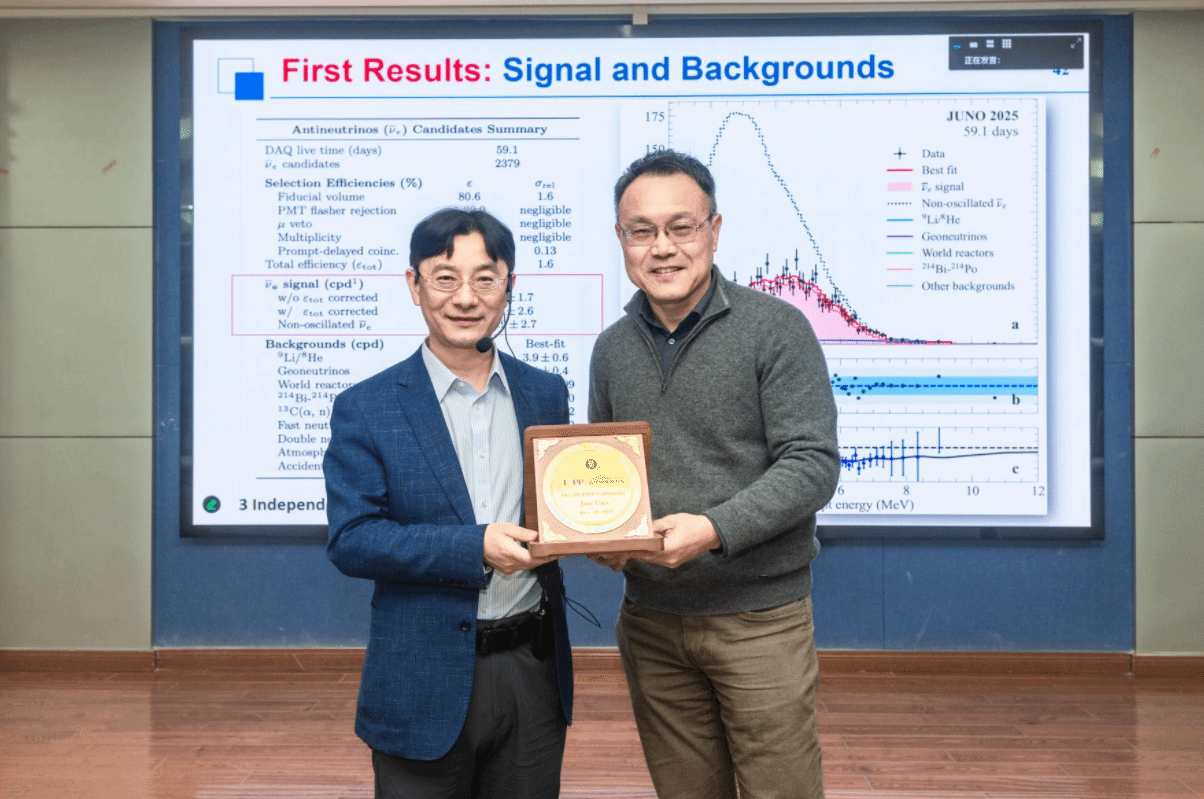
Professor Xin-nian Wang, Director of C3NT and IOPP, presented Professor CAO Jun
with the 5th IOPP Colloquium Commemorative plaque
CAO Jun is a Researcher and the Director of the Institute of High Energy Physics (IHEP), Chinese Academy of Sciences, as well as a “New Cornerstone Investigator”. He graduated from Wuhan University in 1993 and received his Ph.D. from IHEP in 1998. He subsequently conducted postdoctoral research at the French National Centre for Scientific Research (CNRS) and the University of Michigan in the United States. Since 2003, he has been involved in the Daya Bay Reactor Neutrino Experiment, serving as Deputy Project Manager and leading the physical analysis that discovered a new neutrino oscillation mode. Since 2013, he has served as Co-Spokesperson of the Daya Bay Experiment.He is a co-proposer of the Jiangmen Underground Neutrino Observatory (JUNO) and serves as its Deputy Project Manager and Deputy Spokesperson of the JUNO. He also proposed and made a leading role in the construction of the Taishan Neutrino Experiment.
In 2012, Professor Cao received the National Science Fund for Distinguished Young Scholars, and as a key contributor, he received the First Class State Natural Science Award in 2016.
He has been invited to present plenary talks at numerous international conferences, including the International Conference on High Energy Physics (ICHEP), the International Conference on "Neutrino Physics and Astrophysics" (Neutrino), and the "Lepton–Photon conference".
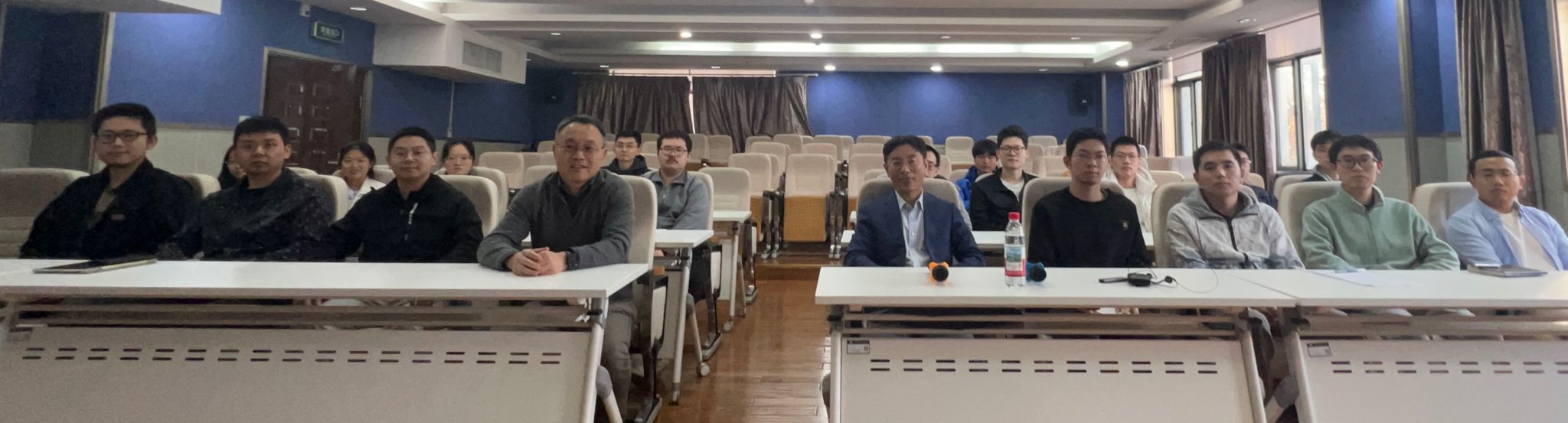
Group Photo of some of the participants of the 5th IOPP Colloquium
Correspondent: Xiangyu Shui
Proof-reader: Hang Yi